| Instrument | Paul Sheridan |
| Category | Imported Classical Guitars 〔New〕 |
| Number/Model | No.256 8/25 |
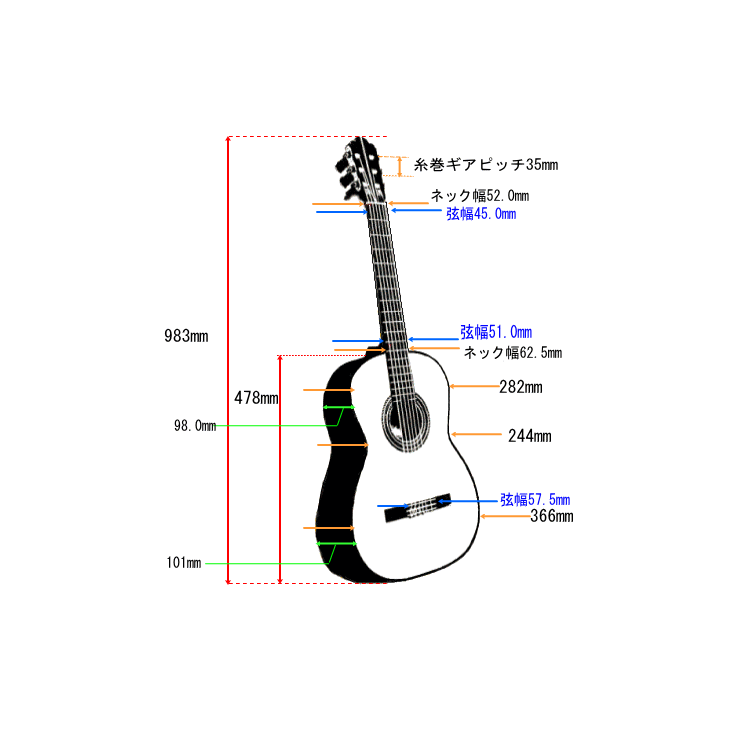
| Scale length | 640mm |
| Country | Australia |
| Year | 2025Year |
| Top | Solid Spruce |
| Side&Back | Jarrah |
| Condition※ | 10 |
| List price | ¥2,750,000 |
| Price (tax included) | Please Inquire |
| option | with Hardcase(HISCOX) |
Click to enlarge the photos below
|
|
 |
 |
 |
 |
 |
 |
 |
 |
 |


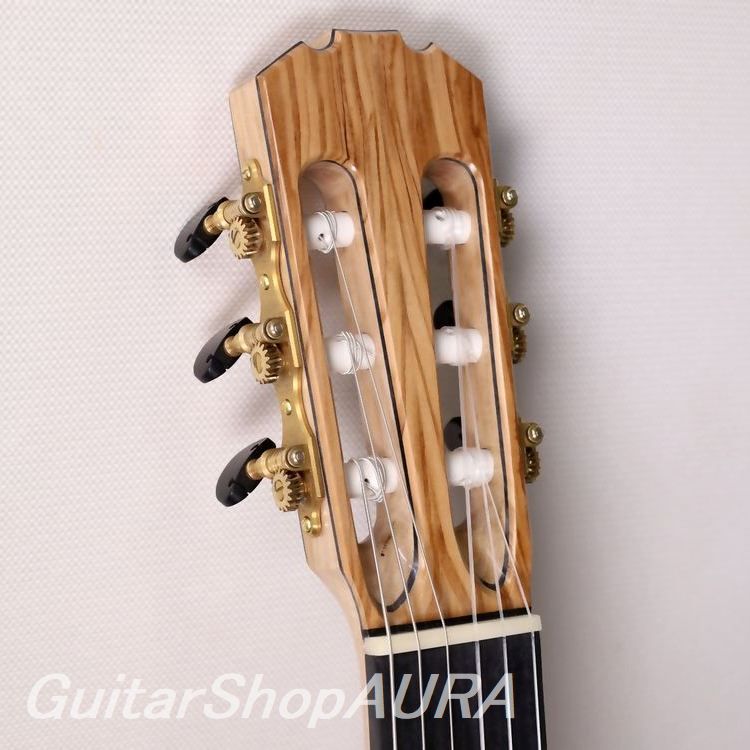
Neck:Tasmanian Oak
Fingerboard:Ebony
Finish(Top):Oil Finish
Finish(Back & Sides):Lacquer
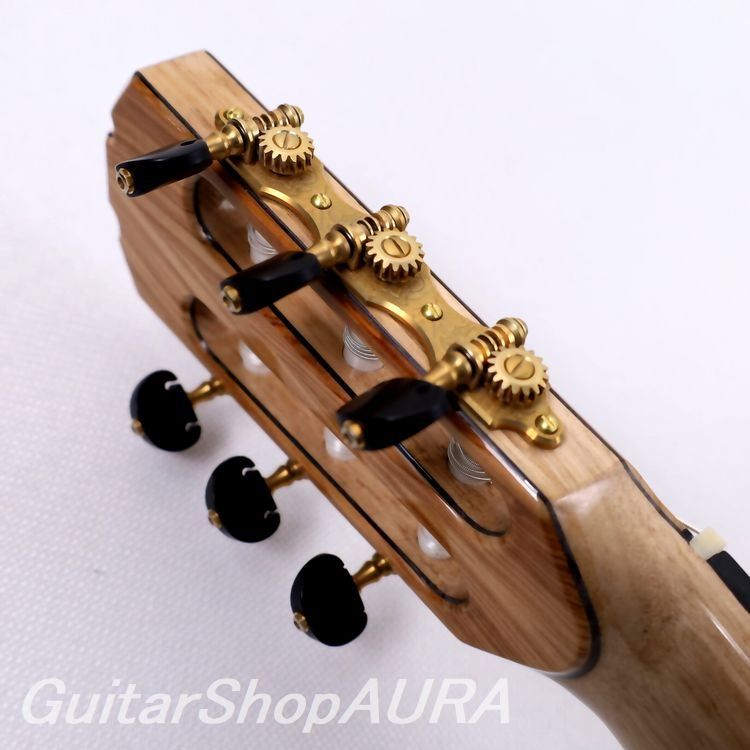
Tuning Machines:GOTOH
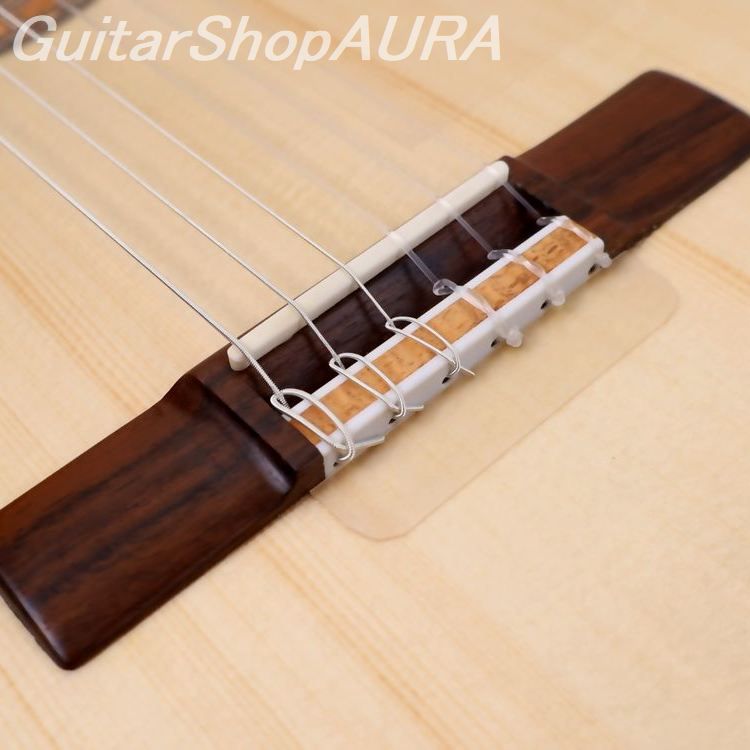
String Height(1st):2.8mm
String Height(6th):3.9mm
[Profile]
Paul Sheridan is one of the most important names among the post–Greg Smallman generation of Australian luthiers. Based in Perth, he began building guitars in 1985, initially in the traditional Spanish style. Later, influenced by Smallman, he adopted the lattice-braced structure, refining it with his own acoustic and engineering ideas to create highly functional instruments with exceptional expressive range.
Today, many concert guitarists play his instruments, but perhaps the most visible among them is Stephanie Jones, the internationally acclaimed Australian guitarist. Her striking performances and her instrument’s distinctive appearance—photogenic in her hands—have left a vivid impression on the eyes and ears of guitar enthusiasts worldwide.
[Description]
This instrument is a 2025 model, Serial No.256.
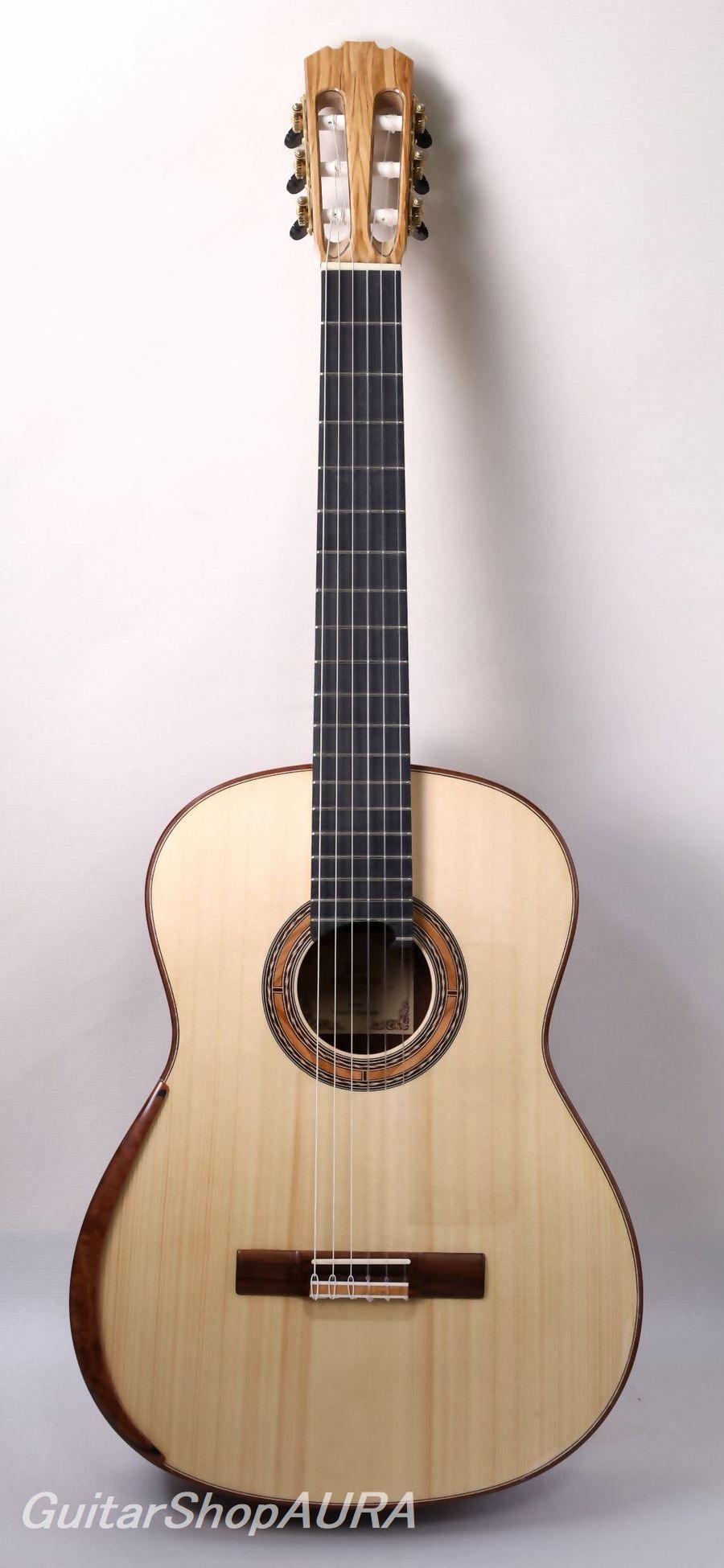
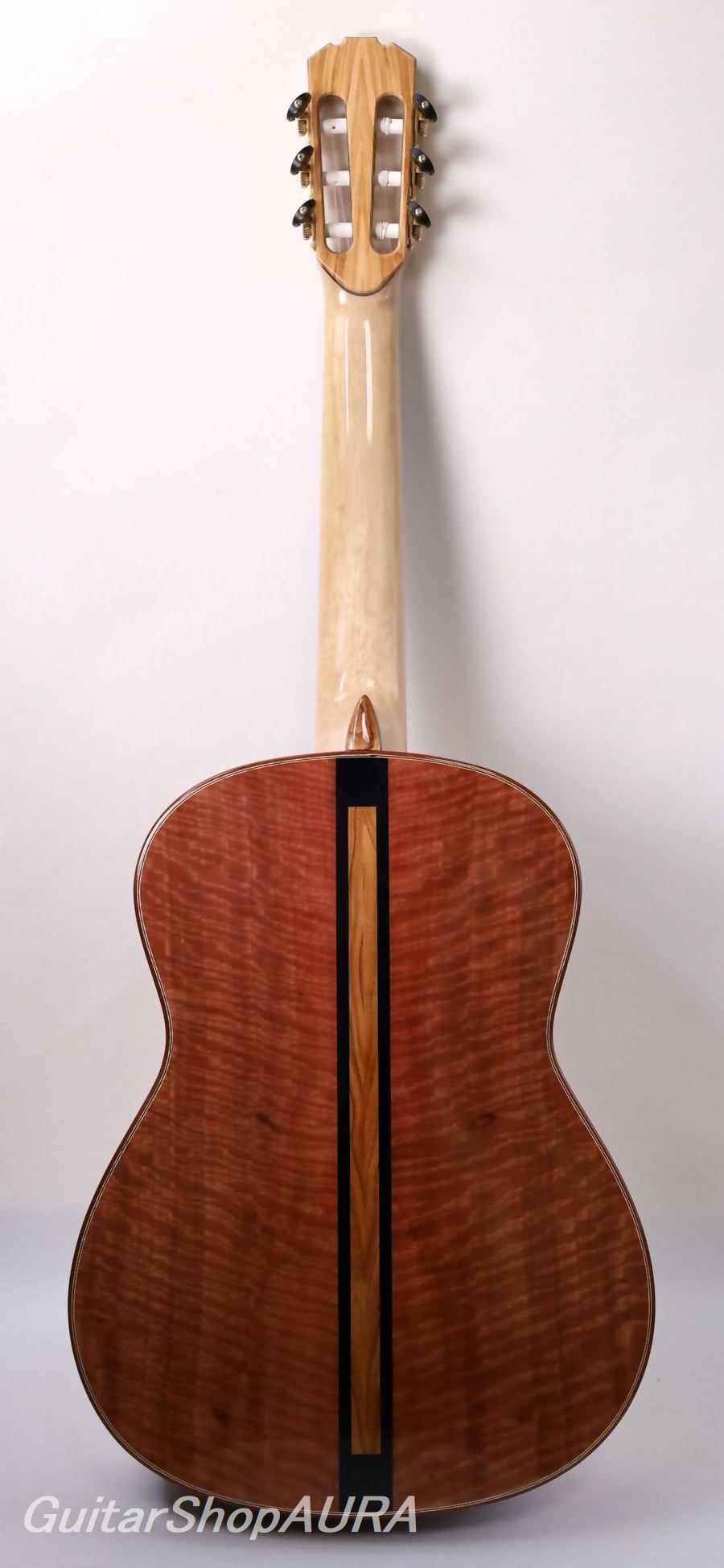
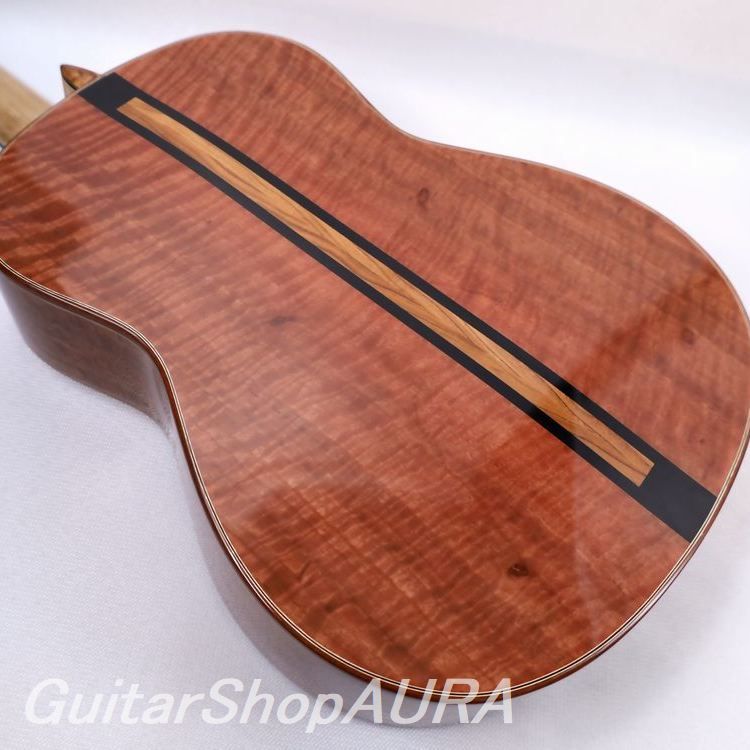
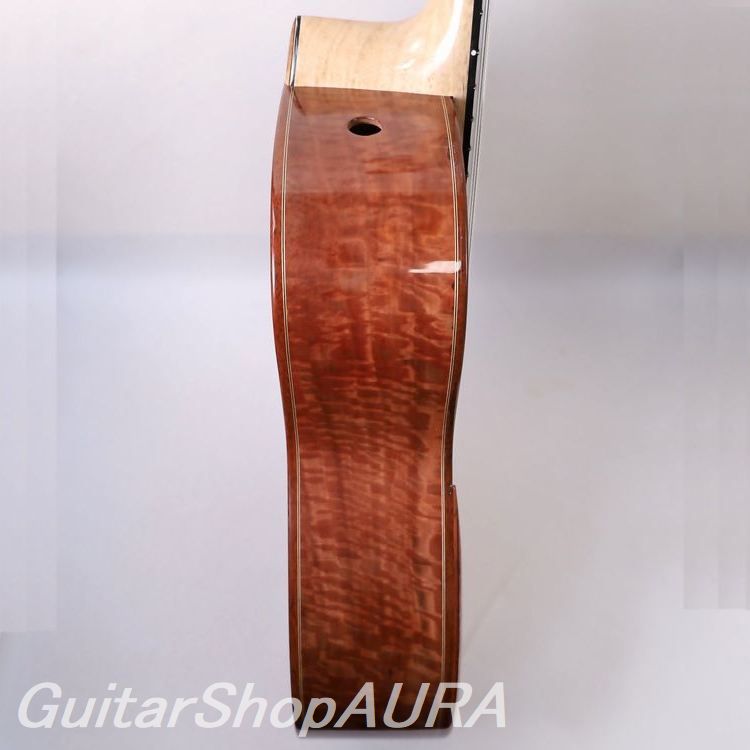
The top is made of Engelmann spruce, while the back and sides use Jarrah, a native Australian hardwood. The top is finished with a matte oil finish that highlights the natural texture of the wood, whereas the back and sides, with their deep reddish hue and bold, rustic grain, are polished to a rich lacquer gloss.
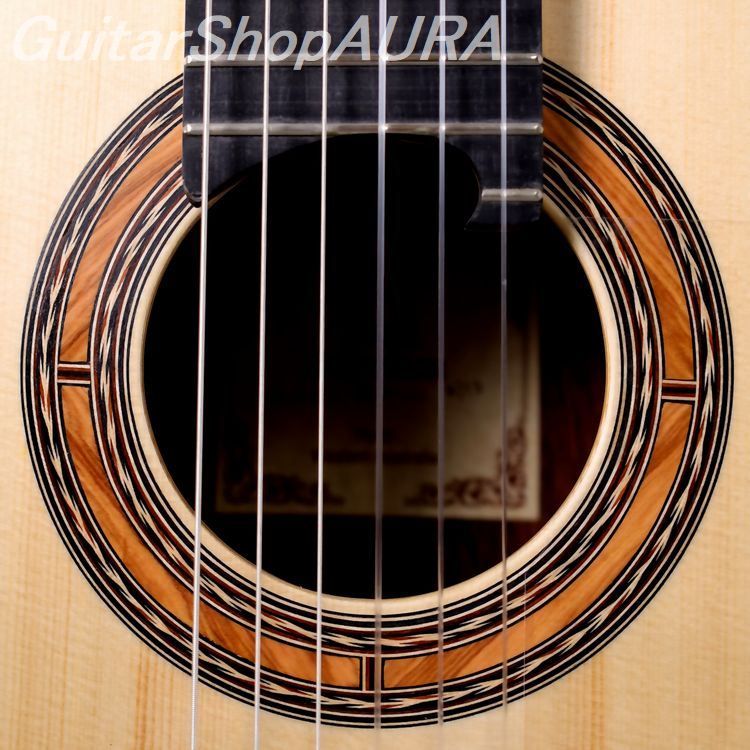
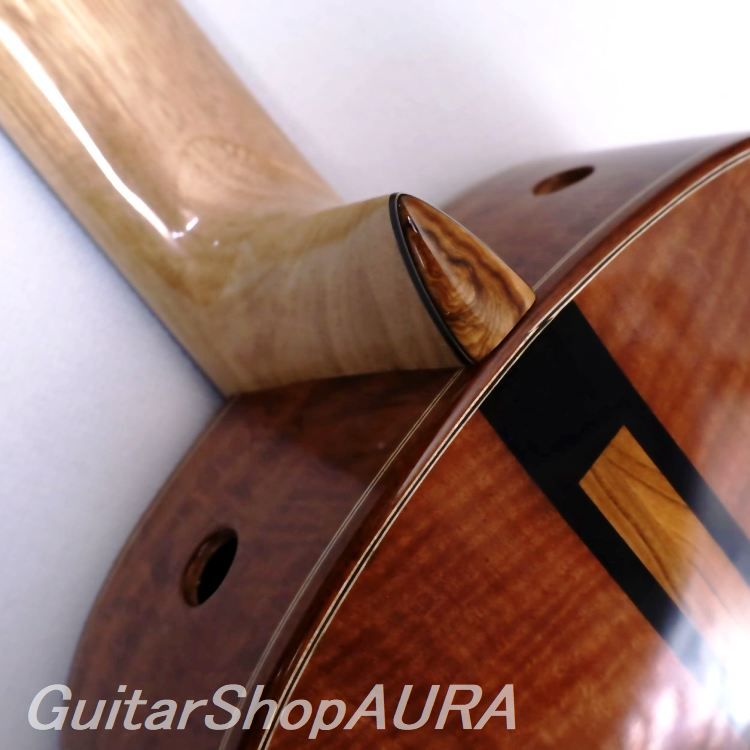
Distinctive square wood inlays are placed at the back center joint and the bottom side joint, crafted from a contrasting wood that is also featured in the square motif of the rosette, creating a strong visual unity. The guitar features a raised fingerboard and an arched back, with the neck heel subtly angled to follow the body curve—an elegant and tasteful detail. An armrest, likely made of Jarrah as well, is fitted to the upper side, contributing both comfort and graceful curvature to the overall design.
Inside the body, the upper bout is reinforced with two robust harmonic bars (approx. 2cm × 2cm) above and below the soundhole, and additional bracing up to the neck joint for exceptional rigidity. The lower bout, in contrast, employs a delicate lattice pattern: ten braces running parallel to the grain and eight crossing them at right angles, forming a perfect grid of small squares. These thin (about 5mm) braces, reinforced with carbon near the bridge, allow flexible vibration across the lower soundboard.
The lining between the top and sides is unusually thick and strong (approx. 1cm × 2.5cm), contributing to the guitar’s structural stability. Two additional 2×2cm bars connect the end block to the sides near the soundhole, further reinforcing the framework. The arched Jarrah back is built thick enough that it requires no internal bracing—its rigidity helps stabilize the entire body except for the vibrating lower soundboard area. This approach closely follows the Smallman-inspired Australian school while incorporating Sheridan’s own refinements, most notably the orthogonal lattice pattern—a grid of perfect squares rather than the typical diamond-shaped design.
The neck, made of Tasmanian Oak (another Australian native wood), is a bolt-on design. Scale length is 640 mm, with a thin D-shaped profile that offers excellent playability. The string height is set at 2.8 mm (1st string) and 3.9 mm (6th string) at the 12th fret, with 2.0 mm of saddle reserve. Dual soundports (18 mm diameter) are located on each side of the heel, enhancing projection toward the player.
Tonally, it possesses the signature traits of the Australian lattice school—fast, percussive attack, dry wooden resonance, and powerful volume—yet what sets Sheridan apart is his instrument’s remarkable responsiveness. The guitar reacts faithfully to the player’s touch, maintaining linearity and control where other lattice designs can feel overly aggressive. It allows nuanced musical shaping—such as gradual crescendos from pianissimo to forte—without strain, offering an emotionally rich and deeply musical experience.
For players seeking a modern concert guitar that combines power with expressive flexibility, this instrument represents an exceptional choice. With a waiting list of over three years, Paul Sheridan continues to be one of today’s most respected and sought-after luthiers, and this new instrument clearly demonstrates why.